
The Philippines authorities have established themselves as one of the important trading economies because of the large consumer market, growing manufacturing sector, and the expanding electronics industry. The international trade ecosystem has created significant opportunities across electronic semiconductors and mineral products, according to Philippines trade data. Philippines Import Data have been valuable sources of intelligence for businesses looking for market expansion.
The trade intelligence helps companies get a proper evaluation of international demand, along with identification of potential buyers and suppliers, and monitoring of competitors. The trade structure influences the electronics and electrical equipment trade of the nation, which has been a major contributor to the Philippines’ export growth rate. The dependence of the authorities on significant imported machinery, electronic components, and mineral fuels has supported domestic production.
THE SIGNIFICANT ROLE OF THE PHILIPPINES IN THE GLOBAL MARKETPLACE
The Philippine authorities have been a valuable tool for global economic growth because of the strategic location along major maritime roads and the connectivity towards East Asia, Southeast Asia, North America, and other international markets. The extensive coastline and network of ports have provided reliable access to important regional shipping routes.
Economic development is supported by electronics manufacturing, semiconductor assembly, and the electrical equipment trade. The electronics and semiconductor sector is particularly important for the Philippines international trade, and the development and establishment of the ecosystem for semiconductor assembly has promoted the manufacturing services.
The Philippine manufacturers have promoted the national technology supply chain. Philippines’ trade data is a proper representation of the importance of major trading partners, including China, Japan, the United States, South Korea, and Asian economies. Rising demand for consumer electronics, automobiles, and machinery has created opportunities for trade for international suppliers.
THE COMPREHENSIVE OVERVIEW OF THE PHILIPPINES IMPORT
Philippines ‘ imports are a result of the country’s sourcing and dependence on imported machinery. The Philippines import market is strongly connected with domestic manufacturing infrastructure investment and energy requirements. Electrical machinery, electronic equipment, and iron and steel articles have been important for the import demand rate. The electronic manufacturing sector promotes continuous supply of semiconductors, electronic components, and production equipment. The manufacturing companies have been dependent on imported industrial materials for incorporation into finished products.
China is one of the largest import sources, while Japan, South Korea, the United States, and Singapore are following the Chinese authorities. Philippines customs data provided the businesses with additional visibility into the sourcing relationship. Trade with different regions has created opportunities for international suppliers of electronic components, semiconductors, machinery, industrial equipment, and energy products. The Philippines import data provides a proper understanding of movement, supply activity in countries of origin, and information for the latest traders.
EXPORT MARKET OVERVIEW OF THE PHILIPPINES
Philippines Export Data properly highlights the positioning of the country as an important supplier of electronic, electrical equipment, machinery components, and agricultural commodities. Electronics and semiconductor-related products are the most important Philippine export categories, according to Philippines shipment data. The data processing equipment and electrical machinery connect the country with the global technology supply chain. The significant export categories basically include machinery and mechanical appliances, copper and mineral products, chemicals, processed foods, and furniture.
The United States, Japan, China, Hong Kong, and South Korea are the most important destinations of the Philippines’ exports. The export structure represents the importance of the country’s electronics manufacturing capabilities while highlighting the opportunities in agriculture, minerals, and other industries. Businesses can use the Philippines Export Data for identification of potential international demand and understanding of the destination market demand rate.
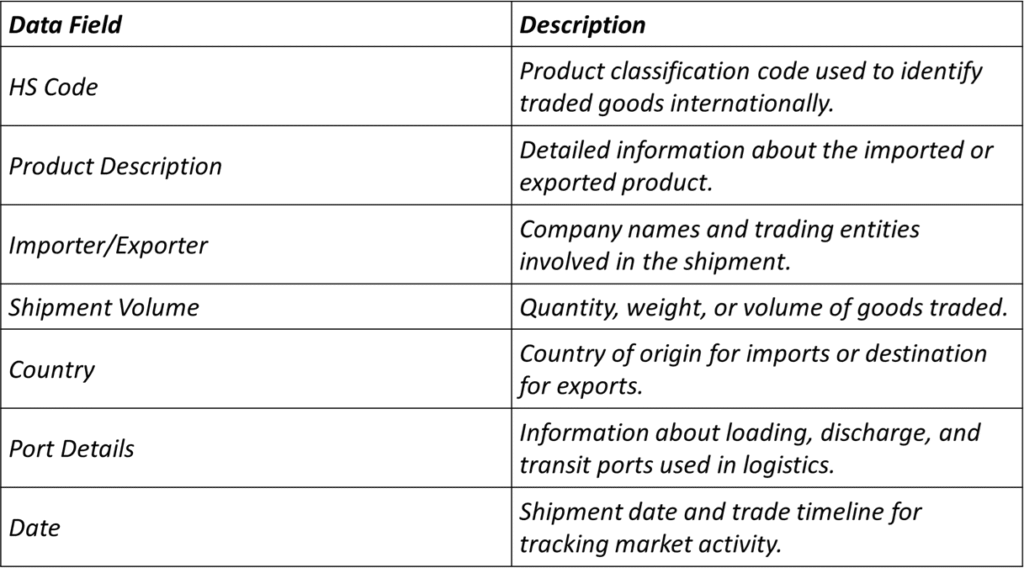
WHAT DETAILS ARE INCLUDED IN PHILIPPINES CUSTOMS DATA?
THE EFFECTIVENESS OF PHILIPPINES IMPORT-EXPORT DATA PROVIDERS IN BUSINESS GROWTH
Philippines import-export data providers have been a valuable tool for business authorities looking to navigate trade complexities. The general statistics provide detailed information to businesses for total import-export product categories and trading partners. Businesses can gain entry into the Philippine market by using the trade intelligence to identify established importers, distributors, and manufacturers.
The Philippines trade data supports competitor analysis. Companies can examine the traditional suppliers and the products they supply. Frequent shipments dominate the specific product categories. The trade information allows businesses to make their market expansion strategies more focused and efficient. Approaching the authorities towards an entire market without sufficient information will prioritize the businesses’ demonstration with actual purchasing activity.
HOW DOES PHILIPPINES IMPORT-EXPORT TRADE DATA FACILITATE BUSINESS GROWTH?
- Identification of global buyers and suppliers – Philippine shipment data gives a clear visualization to the business authorities regarding identification of active buyers, importers, exporters, and manufacturers. The companies can get the latest acknowledgement on purchasing activities for demonstration of the consistent demand rate.
- Analysis of competitor activities – Competitor intelligence on a specific category gives a proper evaluation to the businesses regarding examination of supplier relationships, sourcing countries, and production categories. The information supports stronger pricing, sourcing, and market entry strategies.
- Evaluation of market demand – Philippines trade data helps businesses track changes in product demand rates. The historical shipment activity reveals the fast-growing product categories with changes in sourcing preferences.
- Supply chain optimization – Philippines customs data supports the supply chain analysis by providing information to the sourcing countries. Businesses can use the insights to evaluate alternate sourcing strategies.
- Identification of emerging opportunities – The Philippines’ expansion of semiconductor trade has maintained the statistical growth rate over other regions. Advanced manufacturing has created new opportunities for international suppliers and service providers.
THE TOP BENEFICIARY INDUSTRIES OF THE PHILIPPINES TRADE DATA
- Electronics and semiconductor industry – The electronics and semiconductor industry has been a valuable tool for the Philippines trade data. The establishment of semiconductor assembly and electronic component systems has created strong international trade relationships.
- Electrical equipment industry – The electrical machinery and equipment industry has helped suppliers get the latest information on purchasing electrical components. This industry is responsible for the crafting of power systems and related products trade.
- Machinery and industrial equipment industry – The expansion of the manufacturing and industrial infrastructure has created different opportunities of trade for machinery and industrial components. Machinery exporters can use the Philippines import data to identify active importers with a demonstration of the strongest purchasing requirements.
FUTURE TRADE OUTLOOK OF PHILIPPINES TRADE DATA
The Philippines trade data is closely connected with electronic manufacturing, semiconductor investment, and infrastructure development. The electronics and semiconductor industries are expected to be important contributors to international trade. The increasing investment in advanced manufacturing and semiconductor assembly has strengthened the Philippines’ positioning within the global supply chain. The country has maintained opportunities for trade with a diversified export basket. Mineral processing, agricultural products, and automotive components have contributed to future trade growth.
The digital customs systems and electronic documentation have improved trade visibility. Businesses using Philippines customs data promote shipment-level intelligence with improvement of market forecasting. Accurate trade data will become increasingly important because of the changing tariff policies and geopolitical developments. Businesses will continuously monitor the Philippines import data and Philippines trade data for identification of emerging opportunities.
Conclusion
The Philippines has strengthened its position as one of the reliable traders of Southeast Asia. The strategic maritime location, growing domestic market, and skilled workforce have maintained its participation in the global supply chain. The export performance is strongly supported by electronics, semiconductors, and electrical equipment. The imports have been closely connected to machinery, electronic components, and mineral fuel.
The growing importance of Philippines import data and Philippines customs data reflects the increasing requirement for accurate and actionable trade intelligence. Businesses can use this latest insight for the identification of potential buyers and suppliers. The global trade has become increasingly competitive because of which it helps the businesses make informed decisions along with development of the stronger international expansion strategies. The continuous monitoring of trade movements helps the authorities gain effective acknowledgement of changing tariffs.
CTA
Looking for an expansion in your business in the Philippines, you have landed at the right platform here. Import Globals specialization and comprehensive trade intelligence help business authorities understand importers, exporters, suppliers, buyers, competitors, and shipment activities. The detailed shipment data on Philippines trade provides them with identification of profitable opportunities. Subscribe to www.importglobals.com or drop an email at info@importglobals.com for detailed intelligence on the Philippines latest trade activities to accelerate your global business growth.
FAQs
Que –Why is Philippines export data beneficial for business growth?
Ans -Philippines export data is beneficial for business growth because it gives a proper visualization of potential buyers and export destinations to the authorities.
Que –What is the global trade rank of the Philippines in 2025?
Ans –The global trade rank of the Philippines in 2025 is 18th.
Que –How does Philippines import-export data support business growth?
Ans -Philippines import-export data support business growth via proper identification of buyers, supplier analysis, analysis of market demand, and development of effective market expansion strategies.
Que –What information is available in Philippines trade data?
Ans -Philippines trade data covers Importer names, Exporter names, Shipment date, HS Code, Product Details, quantity, values, pricing information, origin country, importing country & port details.
Que –How frequently is Philippines trade data updated?
Ans -Philippines trade data is updated on a monthly basis.
Que –Where can I get detailed access to the Philippines trade data?
Ans –Visit www.importglobals.com or drop an email at info@importglobals.com for detailed analysis on the Philippines trade data.